

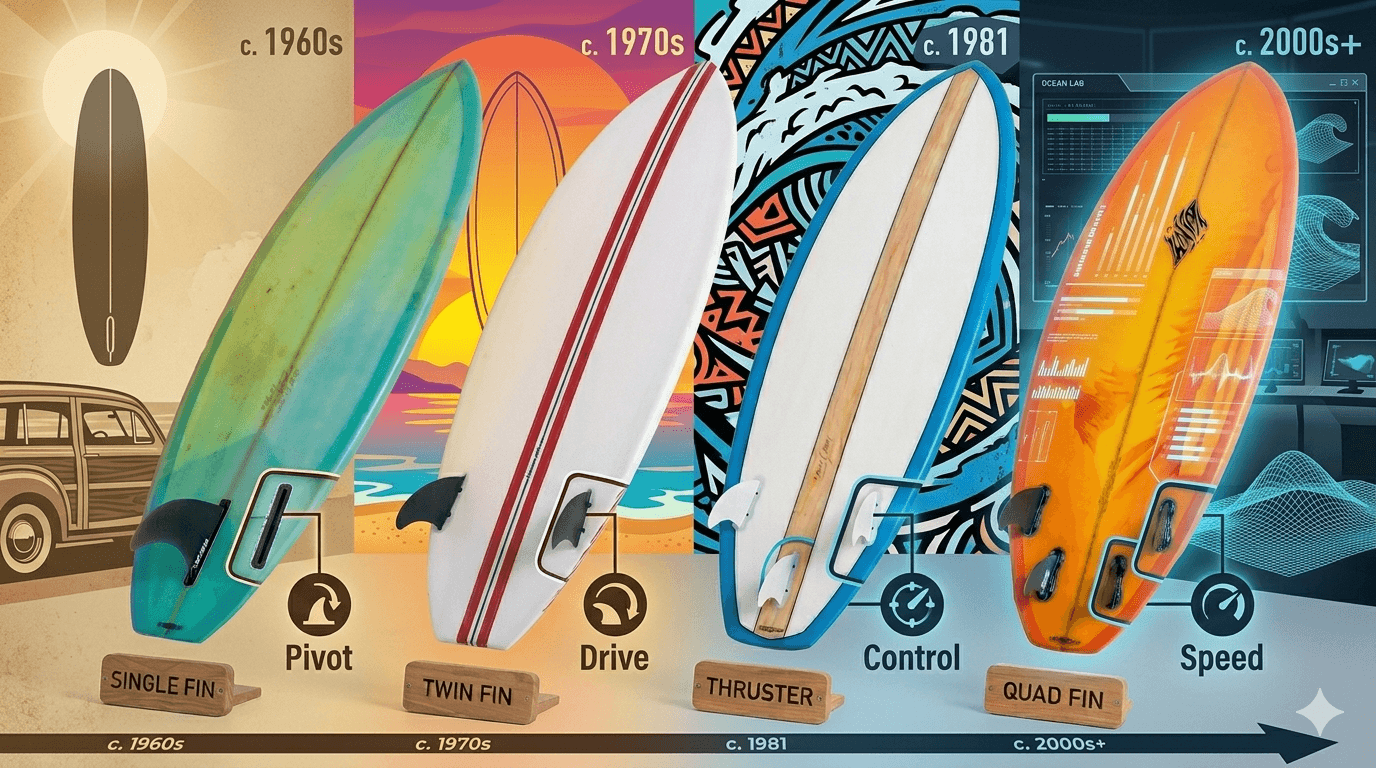
Your surfboard fins are an essential component for riding waves. Fins make the board travel in a straight line instead of sliding sideways, and allow you as the surfer to carve turns on the wave. On the surface, the whole subject seems simple, but in reality the science behind the fins we put on our boards is extremely complex. Don't let that scare you off. This article will give you the tools to understand how fins work and how to arrive at the right setup for you. Surfboard fins have gone through several fundamental changes in style and technological advancement throughout the entire history of surfing. Until the '90s, fin design was largely an afterthought. Today, on the other hand, the science behind fin construction floods the market with new ideas and products almost daily.
The earliest surfers didn't have the advantage of fins on the rear underside of their boards. They controlled the board by dragging one foot in the water to force it to turn and hold some kind of line on the wave!
In 1935, Tom Blake — the legendary surfer and inventor of the hollow surfboard and waterproof camera housing — introduced the world's first fin (a nub keel fin). He borrowed the idea from boating, taking a piece from the hull of an abandoned boat, adapting it and attaching it to a surfboard — catching a rail for the first time without using his feet. His first fin was small and wide: 30 cm long and 12 cm tall. About 10 years later, surfboards started getting lighter, and the effect of the fin contributed even more to the board's maneuverability.
The History
The First Evolution — Single Fin
The first evolution was very slow. Tom Blake's fin was modified by Bob Simmons in the 1940s into a design very similar to what's used today. Simmons pioneered the concept of using multiple fins when he invented the Twin Fin — a board with two fins.
George Greenough was the one who began producing thinner fins with more flex, inspired by the tail of a bluefin tuna. Initially, he used the new fin on his kneeboard. Given the fin's success in the water, the new design made its way to stand-up surfboards when Bob McTavish adapted it to lighter, smaller boards.
The Second Evolution — Twin Fin
In the 1970s, Steve Lis used Bob Simmons' fin on a Twin Fin setup on his innovative Fish boards. Initially, Simmons' fish boards were designed as kneeboards with two extensions on the tail so the surfer could place their flippers on them to reduce drag while maintaining the maneuverability of a pin tail. The first fish soon gained widespread popularity in the surfing world.
Surfers were still riding boards with a single center fin until the early '70s, but that was about to change very soon. Mark Richards (the Australian), who remains one of the most respected shapers in the world to this day, took Steve Lis's Californian fish design and tweaked it slightly. He began competing on the board he'd adapted for himself, stunning surfers and audiences alike with sharp turns on the wave that had never been seen in competition before. As a result, Richards went on to win the world championship title four consecutive times between 1979 and 1982 with his Twin Fin setup, forever changing the style of surfing that existed until then.
The Third Evolution — Thruster
In the 1980s, the use of surfboard fins was about to undergo a radical change. In the late '80s, young Australian surfer Simon Anderson began gaining fame for his ability to surf the big waves of Oahu's North Shore, Hawaii. However, he was frustrated by the fact that he couldn't control Richards' Twin Fin in big surf. One day, he noticed someone with a Twin Fin board that had a small nub in the middle. He tweaked the idea and adapted it for himself, creating a setup of three fins of equal size, which he called the Thruster — and this is the fin setup still in use today. The Thruster allowed surfers to perform more radically with massive spray, something that wasn't possible before. Surfing grew monumentally from the moment the idea was conceived.
For Beginners
If you're just starting out in surfing, you shouldn't feel the subtle differences that come from using different fins. If you have a set of removable fins, it'll obviously be easier for you to experiment with different fin types.
When you're starting out, you'll likely struggle to generate the speed needed to feel the fins' response to water resistance. Also, you don't yet have control over your turns. Don't worry — once you're good enough, you'll have a lifetime to try different fin types.
Once you can catch a rail and ride along the wave, a recommended first experiment is to remove the center fin from a thruster setup. Or try friends' boards with quad fin setups, twin fins, or single fins (usually on longboards and vintage boards).
Removing the center fin will allow you to rotate the board more easily while it still holds your line — this is especially recommended when there are small, weak waves, since then there's no speed and a thruster doesn't like to turn without speed. A twin fin board is easier to tilt from side to side and generate the movement needed for turning.
Fin Types
Fixed Fins (Glass-Ons)
Fixed fins are attached using layers of fiberglass cloth and resin (similar to the surfboard's coating) and cannot be separated from the board. Fixed fins, considered almost a thing of the past, are becoming increasingly rare as removable fin systems gradually take over the surfboard manufacturing market. Currently, fixed fins are mostly seen on retro boards with twin fin setups.
Pros:
- Strength — because they're bonded to the board along their entire base, this creates greater structural strength — if the person installing them knows what they're doing.
- Better performance — the way a fixed fin connects to the board is completely different from a removable fin. The flex pattern and response to pressure will always be slightly different. The difference can only be felt as an advanced surfer. It's worth noting that most professional surfers in the world ride fixed fins.
Most surfboard manufacturers worldwide use both removable and fixed fins on the boards they sell (usually removable), but most believe fixed fins deliver better performance than removable ones.
Cons:
- Repairing a broken fin — the restoration process is very problematic. You'll need to go to your nearest shaper to have the fin reinstalled, or get an entirely new one if the previous one was destroyed or lost.
- No ability to experiment with different fins — fixed fins aren't meant to be removed; they're there forever. In practice, most surfers don't swap fins anyway and stay loyal to one type.
- Cost and complexity — fixed fins are relatively expensive and difficult to do correctly. Removable fins have made shapers' lives much easier — most consider attaching fixed fins the hardest part of building a surfboard.
- Can't detach them for travel — this particularly hurts travelers. The ability to remove fins from the board saves a huge amount of space in board bags.
If you want fixed fins, make sure your shaper knows how to do them well!
Removable Fins
Removable fins are today's popular choice. They've existed since 1954, but they weren't interchangeable and different models weren't available at the local shop. Removable fin systems give you the ability to swap out the fin template you're using, paving a new way to adapt the board to different waves and improve your surfing ability.
Tom Morey was a key name in introducing removable fin systems with different fin types as early as the 1960s.
In the early '90s, new removable fin system manufacturers began emerging alongside the continuing popularity of the Thruster setup (three-fin array). FCS, Futures, Red X, O'Fish'l, and Lok Box were among the industry leaders at the start and remain so today, though several other quality manufacturers have joined over the years.
Pros:
The widespread popularity of removable fins grew so large mainly because of their ease of use, especially for board manufacturers and surf shops. The risk of breaking a fixed fin and ruining a board is no longer an issue with the new solution. Manufacturers and retailers could ship more boards at the same cost with less risk. FCS, for example, emphasized in their marketing the travel benefits of their product in terms of packing and shipping, and of course having Kelly Slater as their marketing front contributed as well. Slater's signature fins, made of blue-and-white plastic, became a symbol of FCS and the innovation they chose to bring to market.
The ability to design precise models using computer software also gave a massive boost to removable fin systems. Fixed fins are shaped during the glassing process after installation, so they'll never be perfectly identical. A few years ago, FCS signed a partnership with a hydrodynamic research institute in Tasmania that also works with airline and Formula 1 companies. In the materials used for fin construction, further advances have been made in recent years. Lighter fins with varying flex patterns resulting from new material combinations are now available.
Cons:
- Unfortunately, there still isn't a single universal removable fin system. Surfers need to find fins that fit the specific system installed in their board. For example, you can't use FCS fins in a Futures system.
- One of the most common problems with removable fin systems is the risk of a fin falling out or snapping off at its base. FCS fins are the main culprits, as their base connection is relatively weak compared to other systems like Futures. That said, the argument stands that it's still better to lose a fin worth $15-30 than to break a fixed fin.
- Most removable fin systems, apart from manufacturers like O'Fish'l, use metal screws to secure the fins. This metal is exposed to wear, corrosion, and degradation, and replacement is problematic. You can extend the screw's lifespan by rinsing with fresh water after every session.
In any case, it's fairly safe to say that in the last 15 years there has been far more innovation and advancement in the field of fins than in surfboard manufacturing itself.


Comments