

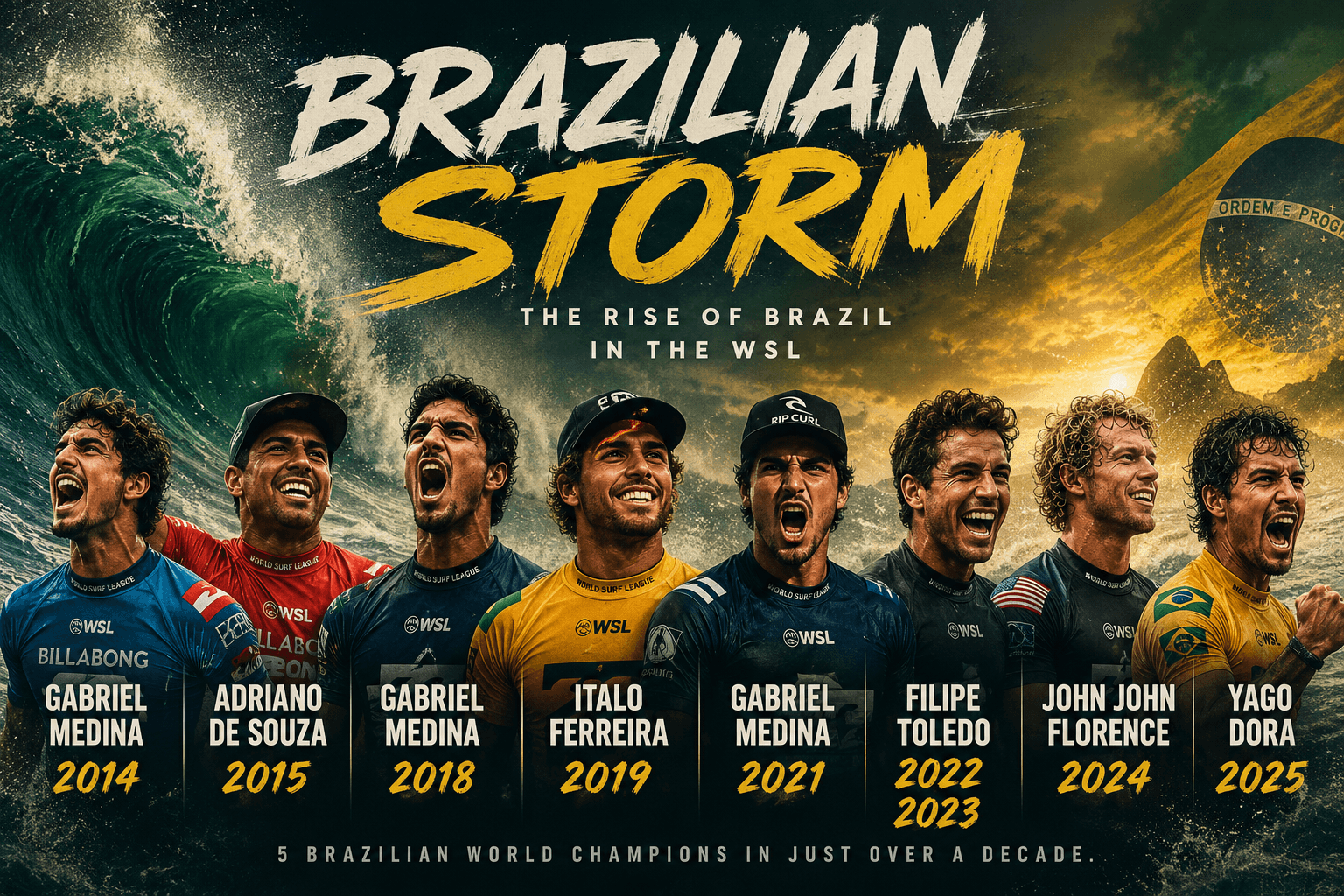
From Adriano de Souza's breakthrough in the 2000s, through Gabriel Medina's takeover in 2014 and de Souza's phenomenal 2015 title, to Yago Dora's crown in 2025. Brazilian surfers have all but taken over the tour after decades of Australian, American, and Hawaiian dominance — today, nearly every quarterfinal features at least two Brazilians. Since 2014, aside from John John's three wins, every world champion has come from Brazil.
In 2011, surf media coined a term that would come to define an era: "The Brazilian Storm".
What started as a wave of hungry young talents from South America flooding the WSL qualifying circuit has since become a full-blown dynasty.
A Decade of Yellow and Green
The timeline speaks for itself:
- 2014 — Gabriel Medina becomes Brazil's first-ever WSL World Champion at age 20, breaking the long-held Australian-American/Hawaiian duopoly.
- 2015 — Adriano de Souza ("Mineirinho") wins the title, proving 2014 was no fluke.
- 2018 — Medina reclaims the crown for his second world title.
- 2019 — Italo Ferreira, the kid who learned to surf on a styrofoam cooler lid in Baia Formosa, wins his first World Championship in a season filled with perfect 10s.
- 2021 — Medina earns his third title, cementing himself as one of the greatest competitive surfers ever.
- 2022 & 2023 — Filipe Toledo goes back-to-back, winning two consecutive world titles with his trademark explosive above-the-lip surfing.
- 2024 — John John Florence breaks the Brazilian streak once again, just like in 2016 and 2017, winning his third title at the Finals in San Clemente.
- 2025 — Yago Dora answers right back, defeating Griffin Colapinto in flawless Cloudbreak conditions to bring the title back to Brazil. He becomes the fifth different Brazilian world champion in just over a decade.
That's eight out of eleven men's world titles from 2014 to 2025 going to Brazil. No other country comes close.
Why Brazil? Five Theories Behind the Takeover
Endless Coastline, Endless Reps
Brazil's 7,500 km of Atlantic coastline rarely goes flat. Dominated by punchy, hollow beach breaks, the conditions produce fearsome beach break surfers. While Hawaiians grow up on reef passes and Australians on point breaks, Brazilians train on fast, unpredictable peaks that turn them into surfers who can adapt to any ocean condition.
Economic Boom Created a Surf Middle Class
Through the 2000s and 2010s, Brazil's economy grew rapidly. The gap between rich and poor narrowed, creating a massive new middle class.
Suddenly, families that previously couldn't afford a surfboard — let alone international travel — could invest in their kids' surfing careers. Sponsorship money from brands flowed into the favelas along the coast, creating an endless pipeline of elite surfers.
Strength in Numbers — The Pack Mentality
Unlike Australian or American surfers who often traveled the QS circuit alone — and similar to Israelis — the Brazilian contingent moved as a pack. They shared coaches, housing, flights, and strategy.
This communal approach created an emotional support system and a competitive edge — when one Brazilian made a heat, the others stood on the beach cheering him on. This team mentality was unlike anything the tour had seen before.
Local QS Events as a Launchpad
Brazil hosted a disproportionate number of regional QS events, giving young surfers the chance to compete against international talent without the financial burden of overseas travel.
Brazilians won over 50% of their home QS events, banking critical ranking points that propelled them onto the Championship Tour.
A Culture That Treats Surfers Like Soccer Stars
In Brazil, surfing isn't a fringe lifestyle sport — it's mainstream entertainment. Gabriel Medina has more Instagram followers than most soccer players.
The Vivo Rio Pro in Saquarema draws tens of thousands of fans to the beach, turning a surf contest into a national event. That level of cultural support and pressure creates athletes who thrive under the spotlight.
How the Storm Changed the Tour
The Brazilian dominance has reshaped the WSL in ways that go far beyond the trophy cabinet:
The Rivalry Era
The Florence vs. Medina matchup — three world titles each — they were both supposed to enter the 2026 season together to continue surfing's defining rivalry, because let's be honest, they're both a level above everyone else.
Their head-to-head heats draw the tour's biggest viewership numbers. Every time they paddle out in the same heat, the surf world skips a beat.
But... John John decided to go sailing with his family and find waves nobody has ever surfed (and the Horbs don't want him back either, to be honest).
Higher Performance Baseline
Brazilian airs and power surfing pushed the entire field to evolve. The average score on the CT has been climbing steadily and the rest of the world had to adapt to compete with Brazil's relentless approach.
Maneuvers that once earned perfect 10s are now standard. The Brazilians didn't just raise the bar — they created a new one.
Fan Engagement and Controversy
Brazilian fans are among the most passionate and vocal in the sport. The energy they bring to events is unmatched — except perhaps by the Israelis.
The fan energy has also sparked debates about crowd influence, judging bias, and sportsmanship. Love them or not, they make the tour more exciting.
The Mid-Season Cut Pressure
With so many Brazilians qualifying for the CT, internal competition within Team Brazil is fierce.
Younger surfers like Samuel Pupo and others fight not just against Australians and Americans, but against their own countrymen for survival past the mid-season cut. Making the tour is hard. Staying on it when half the field is Brazilian is harder.
What's Next: The 2026 Season
The 2026 Championship Tour is shaping up to be one of the most compelling in years.
Gabriel Medina is returning from a pectoral injury that sidelined him for most of 2025.
Meanwhile, reigning champion Yago Dora enters the season with the yellow jersey that was taken by Italo Ferreira.
The question isn't whether Brazil will contend. The question is whether anyone can stop them — because in the current top five after the El Salvador event, the only non-Brazilian is Italy's Leonardo Fioravanti, alongside Pupo, Dora, Medina, and Ferreira who leads by a margin. Ethan Ewing and Jack Robinson, the Australians, and America's Griffin Colapinto round out the chase.
The Bigger Picture
The Brazilian Storm isn't just a surf story — it's a blueprint for how a country can dominate a global sport through a combination of natural resources, economic development, cultural investment, and sheer collective will.
For us here in Israel — a country with a small but fierce and growing surf scene — there's a lot to learn from Brazil's rise. Infrastructure matters. Community matters. And treating young surfers like real athletes, not hobbyists, can change everything.
The storm isn't over. If anything, it's only getting stronger...
Comments