

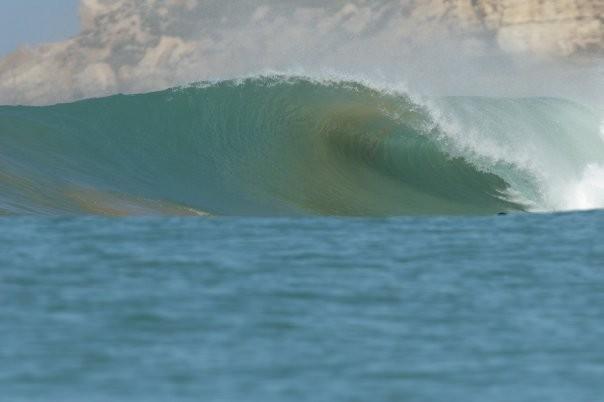
Safi — The Crown Jewel
The best wave in Morocco!!! If you're there when a solid swell hits, chances are you'll see a few pros pop up out of nowhere and show you what's possible on this wave. Located north of the city of Safi — one of Morocco's largest industrial cities (mainly canning and phosphate) — about 4 hours south of Casablanca and north of Agadir (roughly halfway between the two). There isn't much to do in this city, but when the wave is working, nothing besides being in the water and preparing for the next session will matter to you. For the wave to really work it needs a massive swell in the 12ft–15ft range. It works at smaller sizes too, but then it's just not the same. When it's on, you catch the wave near a rock poking out of the water just a few dozen meters in front of a cliff face, then you enter a roller coaster that's one giant barrel breaking along the cliff. After you exit the tube, you could honestly get out of the water and call it a day — but further down the line there are still several hundred meters of standing wall with performance sections, barrels, and whatever else you want. A perfect wave!
Money Wave
On the southern side of the city there's another wave that works mainly in big surf: Money Wave. It's a very heavy wave that comes from deep water and breaks on a sharp reef. The wave sits directly in front of the massive phosphate factory, so check the water before paddling out due to potential pollution. The break is similar to Sunset in Hawaii. When a set comes, massive lines roll in that initially spill, and as the wave enters the inside section all the water crashes onto the shallow reef on the inside. Not recommended for beginners. A punishing wave that makes you pay for every mistake. The entry is also much harder than it looks, so exercise caution.
Imessouane — The Perfect Place
About an hour's drive north of Agadir sits a small town called Imessouane, at the foot of which lie two perfect point breaks. The point on the northern side of town is one of the most fun waves around. It's a perfect, playful wave that's ideal for longboarders — a long right over deep water with spilling sections. Europeans have created a small surf-town vibe here in the desert, an amazing spot especially suited for couples looking for a quiet escape from the chaos of Agadir. The wave itself is perfect for longboarders and very suitable for beginner surfers. The entire beach is incredibly pastoral, so even if you're not staying there, it's highly recommended to make a day trip.
In addition to that wave, there's another one that demands a higher skill level. On the southern side of town there's another bay with a perfect, very long right that works in bigger conditions and is more suited to radical surfers with advanced ability. When it's on, the wave is very similar to Anchor Point.
Beyond Surfing
For the culture-loving surfers among us, three cities are worth visiting that pretty much encapsulate Moroccan culture across the centuries:
Essaouira
Essaouira (Arabic: الصويرة, French: Essaouira), or by its Portuguese name Mogador, is a port city in Morocco on the Atlantic coast between Casablanca and Agadir. The city sits around a 2.5 km wide bay, guarded at its entrance by Mogador Island. The heart of the city lies in the old medina perched on a peninsula at the bay's northern corner, with its port extending out to sea. Around 70,000 people call the city home, historically making a living from trade and fishing, with sardine canning factories still operating. Today the city is gaining momentum as a tourist destination and is popular among windsurfers thanks to the constant winds. The name "Essaouira" means "beautifully designed" or "picture" in Arabic (from the word tsoira), because from a high vantage point the city looks like a beautiful landscape painting. In 2001, the medina was declared a UNESCO World Heritage Site.
The historic city is divided into three quarters:
- The Kasbah — home to the old governmental center.
- The Medina — this triangular-shaped quarter was built between the 18th and early 20th centuries. The medina is bisected by two main axes. One, about a kilometer long, leads from Bab Doukkala in the northeast to Bab el-Minzah and the port in the southwest. The other, about half a kilometer, runs from Bab Marrakech in the southeast to the seafront in the northwest. Their intersection was called "Souk Jdid" or "the New Market," and housed four specialized markets — fish, spices, grains, and general goods.
- The Mellah (Jewish Quarter) — at its peak, home to about 8,000 Jews. It once contained 30 synagogues, though only two remain today — one, "Slat Attia," is closed, and the other, housed in the home of Rabbi Haim Pinto, is maintained by a local resident. The city has two Jewish cemeteries. The older one, containing Rabbi Haim Pinto's tomb, is a pilgrimage site where Jews hold an annual hillula in his memory. The other cemetery is across the street and is known as the new cemetery.
The city's landmarks include its fortifications and towers, city gates (especially the ornate Sea Gate), Mogador Island with its former prison now serving as a bird sanctuary, the mosques and synagogues, the 18th-century Portuguese church, the Sultan's palace, and private historic homes.
Marrakech
Marrakech (Arabic: مراكش, French: Marrakech) is a desert city in southwest Morocco at the foot of the Atlas Mountains. The city has around 340,000 residents, most of Berber origin. The name likely comes from the Berber language, where "mur akuch" means "City of God."
Founded in 1069 by Yusuf ibn Tashfin, the city developed as a trade hub between Morocco's Atlantic coast cities and sub-Saharan Africa. Marrakech served as the capital of the Moroccan kingdom for centuries, which is why it's considered Morocco in miniature.
The city began when ibn Tashfin built a grand mosque, several permanent structures, and a wall — transforming his tribe's nomadic character. By 1072, Marrakech was already a growing city under his undisputed rule. Over 37 years of his reign, ibn Tashfin turned Marrakech into an important commercial center with a strong agricultural hinterland, building a sophisticated irrigation system — parts of which are still in use today — that made the fertile plains flourish.
Known as "The Red City" for the distinctive color of its buildings, Marrakech has been a UNESCO World Heritage Site since 1985. Tourists flock to it year-round, earning it the nickname "Paris of Morocco" thanks to its many architectural gems. The old city is famous for its winding alleys and colorful souks.
Unlike Rabat, the political capital, and Casablanca, the economic capital, Marrakech is Morocco's historic and cultural capital. Every evening at sunset, hundreds of vendors, storytellers, healers, magicians, jugglers, dancers, drummers, snake charmers, performers, and others gather in the main square of the old city, surrounded by thick smoke from dozens of food and grill stalls. The square, Jemaa el-Fna, is lit by hundreds of small lights and becomes a magnet for locals, visitors from other towns, and tourists captivated by the storytellers.
Taroudant
Taroudant (Arabic: تارودانت, French: Taroudant) is a city in Morocco's Souss Valley on the Ouarzazate–Agadir road, with about 70,000 inhabitants. Taroudant lies 70 km east of Agadir, surrounded by two mountain ranges: the High Atlas to the north and east, and the Anti-Atlas to the south.
Taroudant is included in nearly every travel itinerary along the Agadir–Ouarzazate route. Its impressive 7.5 km city wall appears to visitors like a fata morgana in the heart of the desert. Because of the wall encircling the city, Taroudant is known as "The Little Sister of Marrakech." Unlike Marrakech, almost the entire city sits within its walls. The city is famous for its carpets and jewelry.
Mohammed V Boulevard is the main street, leading to "Bab Taroudant," the main entrance gate and one of the city's five gates. For those who haven't visited the tanneries quarter in Fez, Taroudant offers another chance to see a traditional tanneries district.
The main square is Place Assarag, where most of the city's hotels and restaurants are located. The French protectorate over Morocco left its mark on the square's design — sitting in a cafe there, you feel an atmosphere reminiscent of France. Between the Berber souk and the Arab souk lies another main square, Place Talmoklate, characterized by its distinctly Moroccan atmosphere. The shops in the Berber souk offer household goods and food, while the Arab souk features the carpets that gave the city its fame.


Comments